
2.1

data from the website 
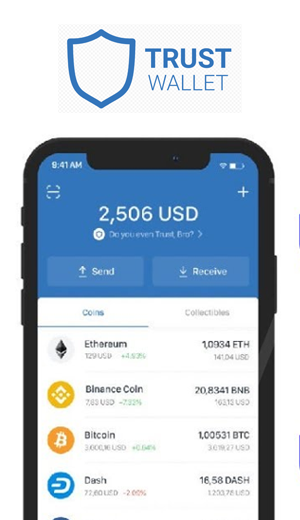
Trust Wallet caught my attention as a multi-currency wallet designed for the modern user. Acquired by Binance in 2018, it became the official wallet of this exchange.
Although Trust Wallet was purchased by a centralized platform, it is built on a decentralized model. This allows users to maintain full control over their funds, with private keys stored directly on their devices.
Trust Wallet does not actually hold cryptocurrency within the wallet itself. Instead, it provides access to your assets, acting as a bridge that connects users to individual blockchains through their nodes.
Now, I’d like to take a closer look at Trust Wallet’s functionality and explore the pros and cons of this solution. Let’s find out whether the word “Trust” in this crypto wallet’s name truly reflects its actual standing.
Benefits
➕ Support for Popular Tokens and Networks
Trust Wallet supports numerous blockchain networks, including Bitcoin, Ethereum, and Tron, allowing you to manage various cryptocurrencies in one place. Another advantage here is the integration of Binance Coin (BNB), since Trust Wallet was acquired by Binance. With BNB, you can pay for transactions on the Binance platform at a discounted rate and participate in sales of the newest tokens on Binance Launchpad.
➕ Rich Functionality
Features such as buying and selling cryptocurrency, instant exchange, and staking have become more of a gold standard than a distinctive advantage. These functions add completeness and convenience to the tool. For me, having all these features in a single wallet represents a significant argument when choosing a solution for managing crypto assets.
➕ Anonymity and Security
The Trust Wallet app allows you to manage cryptocurrencies without the need to disclose any personal data, as it does not collect identifying information. For me, as someone who values privacy and confidentiality, the absence of KYC procedures is a significant advantage. Unlike other wallets that store private keys on their servers, Trust Wallet stores them locally on my device. This guarantees that I maintain full control over my private keys.
Drawbacks
➖ Pushy dApps Integration
When I downloaded the app, I was offered two ways to create a wallet: via email or using my Apple ID. Obviously, such actions require personal data, which blatantly violates my privacy—not to mention that my email address could end up in so-called “blacklists” or be used for phishing. In any case, why would I want problems that could be avoided by simply choosing a different wallet?
Additionally, users will have to undergo a KYC procedure, which becomes mandatory once a certain account balance is reached. However, the exact threshold that triggers this procedure is not specified, raising further questions.
➖ Hidden Fees
I decided to experiment by transferring USDT to SOL, using both Trust Wallet and IronWallet to compare rates. In IronWallet, the fee was zero dollars, whereas in Trust Wallet I paid a full $0.35 for the exact same operation. This isn’t just a difference—it’s outright deception!
One thought keeps bothering me: why overpay and enrich someone else at my own expense? Paying someone just to transfer my own money is absurd. Cryptocurrency was created to provide greater freedom and opportunity—not to force us into paying extra fees.
I prefer to manage my assets in a way that maximizes my benefits, rather than donating to services that charge us unnecessary fees. It’s unbearable!
➖ Anonymity Concerns
I’ve noticed that people around me constantly emphasize Trust Wallet’s advantages, citing its connection to one of the world’s largest crypto exchanges. This creates an illusion of reliability, making users believe that every aspect of using this wallet is completely safe. In reality, the link to Binance may expose crypto assets to various risks.
Binance’s regulatory policies and restrictions could unexpectedly affect Trust Wallet users. We all know how quickly the rules can change, and at any moment, additional verification requirements or wallet access restrictions could be imposed. In such a scenario, all cryptocurrency operations could be jeopardized—calling into question the very essence of decentralization.
Conclusions
Based on my analysis of Trust Wallet, I’ve concluded that this multi-currency wallet is a convenient and functional tool for managing crypto assets. Its support for various blockchain networks and tokens meets the needs of modern users. Integration with Binance also provides access to ecosystem benefits, including transaction discounts and early access to new tokens.
Despite all these advantages, Trust Wallet has its drawbacks. For instance, its connection to Binance raises concerns for me regarding security and privacy, while high fees and pushy decentralized applications add to my hesitation.

Overall, Trust Wallet handles its core task well and almost lives up to its name, as it does inspire a certain degree of trust. However, when it comes to my personal preferences, I lean more toward IronWallet, which today represents a more secure and functional product.
Trust Wallet remains a solid choice, but for me, it still falls short of IronWallet—which better aligns with my expectations for a crypto wallet.