


Anonymous wallets without verification are a useful tool for those who want to maintain confidentiality when storing and transferring cryptocurrency. Despite increasing regulation and mandatory KYC procedures on exchanges, blockchains themselves allow users to utilize cryptocurrency without sharing personal data with third parties.
In this article, we will explore how to choose and create a wallet without verification in 2025.
Anonymous Crypto Wallet Without Verification for Russia
How to Choose an Anonymous Crypto Wallet
When choosing an anonymous crypto wallet, it is important to consider three main parameters: privacy level, ease of use, and technical features.
Privacy Level The level of privacy depends on whether the wallet collects user data and whether verification (KYC) is required. Truly anonymous wallets do not require linking to a name, phone number, or email address, nor do they request documents during creation. An additional plus is the ability to use the wallet on a network with enhanced privacy, such as Monero or Zcash, or connecting via Tor or VPN to hide your IP address when interacting with the network.
Ease of Use Ease of use is determined by the availability of mobile/desktop versions, the ability to quickly create and restore access via a seed phrase, support for required cryptocurrencies, and an intuitive interface. If you plan to use a wallet without verification for regular operations, pay attention to the simplicity of interaction and the application’s speed.
Technical Features It is better to choose crypto wallets without verification that have open-source code. Developers usually prepare distributions and accompany them with their signatures, which allow users to verify the absence of hidden data collection mechanisms. Support for multi-signatures, seed phrase backup, and the ability to work without a constant internet connection (cold storage) enhances security. For regular operations, support for built-in exchange or interaction with decentralized exchanges without KYC is useful.
It is important to remember that the wallet itself does not guarantee complete privacy if deposits/withdrawals are made from identified exchange accounts. Use wallets in combination with OPSEC practices: storing the seed phrase offline, connecting via VPN or Tor, and using anonymous methods for deposits/withdrawals to achieve maximum confidentiality.
Best Anonymous Crypto Wallets in 2025
The market for anonymous crypto wallets continues to evolve, offering users new tools for protecting privacy.
Wasabi Wallet (Bitcoin Wallet) Why choose:
- Protocol-level privacy thanks to CoinJoin.
- Ability to use Tor directly within the wallet.
- Simple interface.
Wasabi Wallet is one of the most well-known wallets for those who want to enhance the privacy of Bitcoin transactions. It uses CoinJoin technology, which allows combining transactions from multiple users into one, obscuring the link between sender and recipient. The wallet is open-source, available for Windows, macOS, and Linux, requires no KYC, and does not store your data. For additional anonymity, it supports operation via Tor.
Samourai Wallet (for Bitcoin) Why choose:
- Convenient for mobile use.
- Advanced privacy features (Stonewall, Ricochet).
- Support for Tor and VPN.
Samourai Wallet is designed specifically for confidential Bitcoin operations on Android devices. It supports the Stonewall function, which obscures links between transactions, and PayNym for generating public addresses without revealing your identity. The wallet also allows operation via Tor and VPN.
Electrum Wallet (in combination with Tor and CoinJoin) Why choose:
- Simple interface.
- Flexible settings for enhancing privacy.
- Support for numerous plugins and multi-signature.
Electrum itself is not an anonymous crypto wallet, but thanks to its openness and plugin support, it can be used to enhance privacy. In combination with Tor and CoinJoin plugins, Electrum allows creating confidential transactions and working without transmitting data to third-party services.
Cake Wallet (for Monero and Bitcoin) Why choose:
- Privacy built-in at the Monero protocol level.
- Convenient mobile application.
- Cryptocurrency exchange available via third-party services.
Cake Wallet is a convenient mobile wallet for iOS/Android, supporting Monero and Bitcoin. Monero (XMR) is known for its built-in privacy: each transaction is protected by ring signatures, stealth addresses, and confidential transactions. Cake Wallet requires no KYC and provides a user-friendly interface for working with Monero.
IronWallet (Multi-Currency Wallet) Why choose:
- Multi-currency support and compatibility with popular networks.
- Convenient mobile interface and NFC backup card.
- 24/7 support in Russian.
IronWallet is a non-custodial mobile wallet without verification. The application allows managing cryptocurrencies without registration, identity verification, or linking a phone number or email. All keys and the seed phrase are stored solely by the user. The wallet supports Bitcoin, Ethereum, Tron, TON, Solana, and other EVM networks, while built-in functions allow buying, selling, and exchanging tokens directly within the interface.
The interface is translated into 21 languages and is intuitive. For backup, an NFC card with the recorded seed phrase is offered.
How to Choose a Wallet Based on Your Goals
There is no perfect, universal wallet—rather, there are wallets suitable for different situations. Let’s review typical scenarios.
For Daily Payments If you plan to use cryptocurrency for regular purchases or transfers—choose mobile wallets with quick access and built-in privacy protection. Good options would be Samourai Wallet for Bitcoin and Cake Wallet for Monero: they allow quick sending/receiving of funds and do not require complex settings. For greater privacy, use a connection via Tor or VPN, and for Bitcoin, apply CoinJoin features (in Samourai) or use the Monero network to hide transactions.
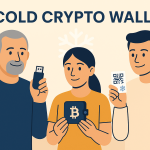
For Long-Term Storage If the goal is to preserve cryptocurrency without third-party access and minimize data leak risks, it is better to use wallets that can be configured as cold (offline) storage. Electrum and Nunchuk allow creating wallets without an internet connection, using multi-signatures, and storing private keys on an offline device. This approach is suitable for long-term storage of large sums but requires careful handling of the seed phrase and a secure storage location.
For Maximum Anonymity in Transfers For users for whom transaction anonymity is critical, the best choice will be wallets working with Monero (XMR), since this network ensures privacy at the protocol level. Cake Wallet allows easily sending/receiving XMR without revealing data and also supports multi-addressing and hidden transfer amounts. If you prefer Bitcoin, Wasabi Wallet or Samourai Wallet with CoinJoin will help enhance the privacy of your transactions.
For Use in a Team or Family If joint ownership of funds is needed (e.g., family budget or business reserves), pay attention to wallets with multi-signature support. Nunchuk allows creating multi-signature wallets and managing access between participants, maintaining control over funds without needing to trust a single party. This enhances security and distributes responsibility among multiple users.
How to Create a Crypto Wallet Without KYC Verification
Creating an anonymous crypto wallet does not require submitting a passport, selfie, or other personal data if you use wallets not linked to centralized services/exchanges.
Here is a step-by-step process for doing this correctly.
Downloading the Wallet from Official Sources Download the application from the official website or app store (Google Play, App Store) to avoid counterfeit versions.
When working with desktop wallets, additionally verify the checksums (SHA256) of the installation file to ensure its authenticity. Sometimes verification is made slightly more complex (e.g., for Electrum) using the developer’s signature. In any case, this is an important step—do not neglect it, as it guarantees the absence of “backdoors” (malicious code) within your application.
Installing the Wallet After installation, open the application and select “Create New Wallet.” In most cases, the creation process includes:
- Generating a seed phrase (12–24 words)—this is the only way to restore access.
- Setting a PIN code or password for local application protection.
It is important to immediately write down the seed phrase on paper and store it in a secure location.
Configuring Additional Security Measures To enhance anonymity, immediately configure a connection to Tor (if supported) or use a VPN to hide your IP address. In some wallets (Wasabi, Samourai), you can enable CoinJoin features to hide transaction history.
Funding the Wallet Anonymously To maintain anonymity, avoid funding the wallet directly from an exchange where you underwent KYC. Instead, you can:
- Use P2P exchangers that do not require verification.
- Receive cryptocurrency from other users.
- Use cryptocurrency ATMs that do not require KYC for small amounts.
Note that modern banks monitor transactions with fiat (traditional) money. The intersection of the traditional money world and the crypto world—where your assets are converted into each other—is under supervision.
When conducting transactions with fiat money, pay attention to the information about yourself that you disclose to conduct traditional money transfers.
Verifying Access After funding, it is worth sending a small amount to another of your wallets or addresses to verify that all settings are working correctly. Use private addresses and transaction-hiding features if they are available on the network.
Conclusion
Anonymous crypto wallets remain one of the few tools that allow managing your assets without intermediaries and without revealing your identity. But in practical use, they require a careful and disciplined approach. Privacy in cryptocurrency is not only—and not even primarily—about choosing the right wallet, but about knowing how to use it without mistakes: applying new addresses for each transaction, avoiding deposits from KYC exchanges, using Tor or VPN, and when necessary—private networks like Monero.