


The cryptocurrency market is still significantly smaller than the stock market, but it is already comparable to the revenue of the world’s largest corporations and exceeds the GDP of several developed countries. Against the backdrop of growing interest in digital assets, the question of secure storage is becoming increasingly important.
Hot crypto wallet for working with the world’s leading cryptocurrencies
Everyone who encounters cryptocurrencies quickly learns about the difference between cold and hot wallets. Cold wallets are used for long-term asset storage—they are not connected to the internet, which reduces theft and hacking risks. Hot wallets, on the contrary, provide quick access to funds and allow transactions at any time, but require special attention to security issues.
In this article, we will explain what hot wallets are, how they are structured, why they are needed, and who they are suitable for.
Hot Cryptocurrency Wallet: Key Features
In their operation, cryptocurrencies rely on encryption. Modern encryption algorithms assume that there is a private part of the encryption key (secret) and a public part, which is used to verify that a transaction was signed by the exact private key paired with the public one.
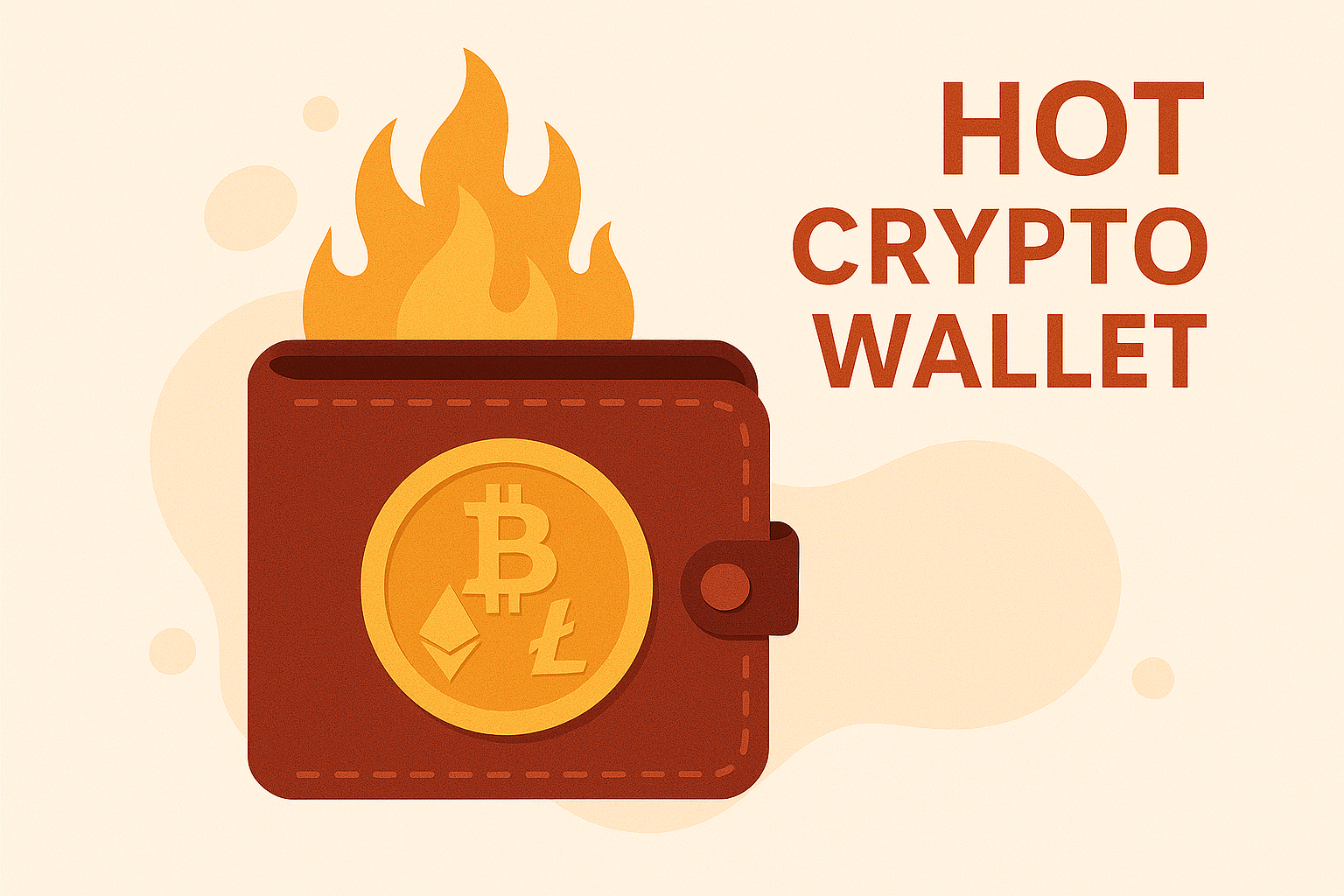
A hot wallet is a method of storing cryptocurrency in which private keys are located on a device or server that is constantly connected to the internet. Simply put, a hot crypto wallet is always online, which allows you to quickly manage your digital assets and conduct transactions at any time.
A cold wallet is used to store cryptocurrency without a constant network connection, which reduces hacking risks but makes using coins less convenient for everyday operations. Hot wallets, however, provide instant access to assets, which is especially important when working with DeFi, NFTs, exchanges, and daily payments.
There are several types of hot cryptocurrency wallets:
- Mobile applications. Installed on a smartphone and suitable for regular cryptocurrency use. Such wallets allow paying for purchases, quickly transferring funds, and interacting with DeFi and NFT platforms. The user manages private keys independently and can work with assets anywhere there is internet.
- Desktop programs. Installed on a computer, providing more convenient management of large sums. The user has full control over private keys and can use advanced features.
- Web wallets. Accessible via a browser; they may store keys on the user’s side or on the provider’s server. Convenient for quick access but require special attention to security.
- Crypto wallets on exchanges. Created automatically upon registration on cryptocurrency exchanges and allow storing assets for trading. In this case, private keys are stored by the exchange, so such options are convenient for trading but less secure for long-term storage. They are subject not only to hacking risks but also to intentional or forced actions by the exchanges themselves (e.g., blocking at government request or simply theft by dishonest owners).
Hot cryptocurrency wallets are a tool for those who want to quickly use their digital assets, manage them in a few clicks, and interact with the blockchain ecosystem in real time.
How Hot Wallets Work for Storing Cryptocurrency
To understand how hot wallets work, you need to understand the key concepts of blockchain—the public and private key. The public key is used to receive cryptocurrency and represents the wallet address, which can be freely shared with other users. The private key grants full access to managing cryptocurrency at that address and must be stored securely, as its loss or compromise is equivalent to losing funds.
In hot wallets, the private key is stored on the user’s device (smartphone, computer) or on the wallet provider’s server, in the case of web wallets or exchange wallets. Thanks to constant internet connectivity, you can conduct a transaction at any moment, sign it with your private key, and send it to the network for processing.
Hot wallets provide instant access to assets: simply open the application or browser, and you can immediately send or receive cryptocurrency. This is convenient for quick transfers and interaction with blockchain-based services.
For transactions to be processed on the network, a hot crypto wallet connects to blockchain nodes. Nodes accept the transaction, verify its correctness, and add it to the blockchain after confirmation. Some crypto wallets use their own nodes; others connect to public nodes or provider servers to interact with the network.
Advantages of Hot Crypto Wallets
Thanks to constant internet connectivity, you get quick access to your funds and can send or receive cryptocurrency at any moment without connecting additional devices or performing complex procedures.
Hot wallets are suitable for daily operations: paying for purchases, transferring to friends, working with exchanges, participating in trading, and interacting with services that accept cryptocurrency.
Installing a mobile application or browser extension takes just a few minutes, and creating a crypto wallet usually requires no technical knowledge. Most modern hot wallets offer intuitive interfaces, built-in hints, and step-by-step instructions for beginners.
Additionally, hot crypto wallets enable connection to DeFi and dApps. Users can participate in farming, staking, lending, trade tokens and NFTs, and interact with smart contracts directly through the wallet—without resorting to third-party services or losing control over their funds.
Disadvantages and Risks of Hot Wallets
Hot wallets carry risks of phishing and malware infection. A user might accidentally enter their seed phrase or login credentials on a fake website, losing control over their assets. Malicious programs that infect a device can intercept data, substitute addresses when sending transactions, or steal private keys.
There is a risk of losing access to assets if the device is lost and the user has not created and saved a backup of the seed phrase. Losing a phone or damaging a hard drive without a backup effectively means losing all cryptocurrencies stored in the wallet.
It is also necessary to consider the risks of storing funds on centralized platforms (exchanges and online services) that provide hot wallets. In this case, control over private keys remains with the platform, not the user. This simplifies work and ensures quick access to funds but creates dependence on the platform’s reliability. In case of an exchange hack or company bankruptcy, the user may lose access to their funds, as has happened in several cases with major centralized exchanges.
In fact, the risks are so significant that it is recommended to store on hot crypto wallets only the amount you are willing to lose, while transferring the main part of your assets to cold storage.
Who Is a Hot Cryptocurrency Wallet Suitable For?
Hot wallets are optimal for users who frequently conduct transactions. If you transfer cryptocurrency daily, pay for goods and services, or exchange assets with other users—a hot crypto wallet provides convenience and speed.
These crypto wallets are also suitable for those who interact with DeFi, NFTs, and exchanges. To participate in staking, farming, NFT trading, and use decentralized applications (dApps), you need quick access to assets, the ability to sign transactions, and direct interaction with smart contracts. Hot wallets allow you to do this without unnecessary intermediate steps, lowering the entry barrier into DeFi and Web3 ecosystems.
How to Choose a Hot Cryptocurrency Wallet
When choosing a hot wallet, start by checking support for the cryptocurrencies you need. For example, if you use Ethereum and ERC-20 standard tokens, MetaMask and Trust Wallet are suitable. For working with Solana, Phantom is convenient, and if you need a wide list of coins, including Bitcoin and Litecoin, consider Exodus.
The reputation and security of the crypto wallet are of paramount importance. MetaMask and Trust Wallet are open-source solutions with years of history and active developer support. They use private key encryption and allow connecting two-factor authentication via external services. Exodus is also known for regular updates and attention to security, although it is not fully open-source. Phantom encrypts keys locally on the device, while exchange crypto wallets from Binance and Coinbase provide basic protection levels, including 2FA, but require trust in a centralized platform.
Interface convenience is important for daily use. MetaMask has a concise interface, convenient for connecting to DeFi applications via browser or mobile app. Trust Wallet stands out for its simplicity in adding new tokens and a built-in dApp browser. Exodus offers a clear and intuitive interface with charts and sections for exchanging and sending. Phantom is minimalist and works quickly in the Solana ecosystem, including convenient connection to NFT marketplaces. Exchange options from Binance and Coinbase are convenient for quick access to trading and monitoring assets via the app.
Backup capability is a mandatory criterion. MetaMask, Trust Wallet, Exodus, and Phantom allow saving the seed phrase during registration so that in case of device loss, you can restore access to assets. Exchange crypto wallets from Binance and Coinbase use recovery via email and two-factor authentication, but control over private keys remains with the exchange, not the user. This means you do not fully own the cryptocurrency in exchange wallets.
Advantages of IronWallet
IronWallet is a good choice if you need a universal wallet. It allows managing crypto assets without registration or KYC procedures, preserving confidentiality and control over your funds. IronWallet supports Bitcoin, Tron, Solana, TON, and EVM networks, meaning you won’t be limited in choosing tokens for storage and use. You will also appreciate the ability to send tokens on Tron and Ethereum networks without needing to hold ETH or TRX to pay gas fees.
IronWallet has a simple and intuitive interface. You can quickly switch between crypto wallets for different tasks, sort tokens by networks, and customize the display of value in a convenient currency. The application allows quickly sending and receiving tokens, buying cryptocurrency, and withdrawing funds to a card without extra fees or complications.
IronWallet offers convenient seed phrase management. You can safely create and save it during the wallet’s first launch to restore access to assets at any time. The developers offer an NFC card for storing the seed phrase: you order it, record the phrase on it, and store it in a secure location. If you lose your phone or delete the app, the NFC card will help quickly restore access to the crypto wallet without unnecessary actions or risk of losing funds.
Conclusion
Most cryptocurrency users begin their journey with hot wallets. They provide quick access to assets, enable participation in DeFi, work with NFTs, and conduct transactions at any time. It is the hot crypto wallet that makes using cryptocurrencies convenient. But convenience requires greater user responsibility: you need to carefully approach the choice of crypto wallet, follow security measures, store seed phrases in a reliable location, and not keep more funds on hot wallets than you are ready to use actively.